



PCD Pharma Franchise: Complete Guide to Starting a Pharma Business in India
AI Summary
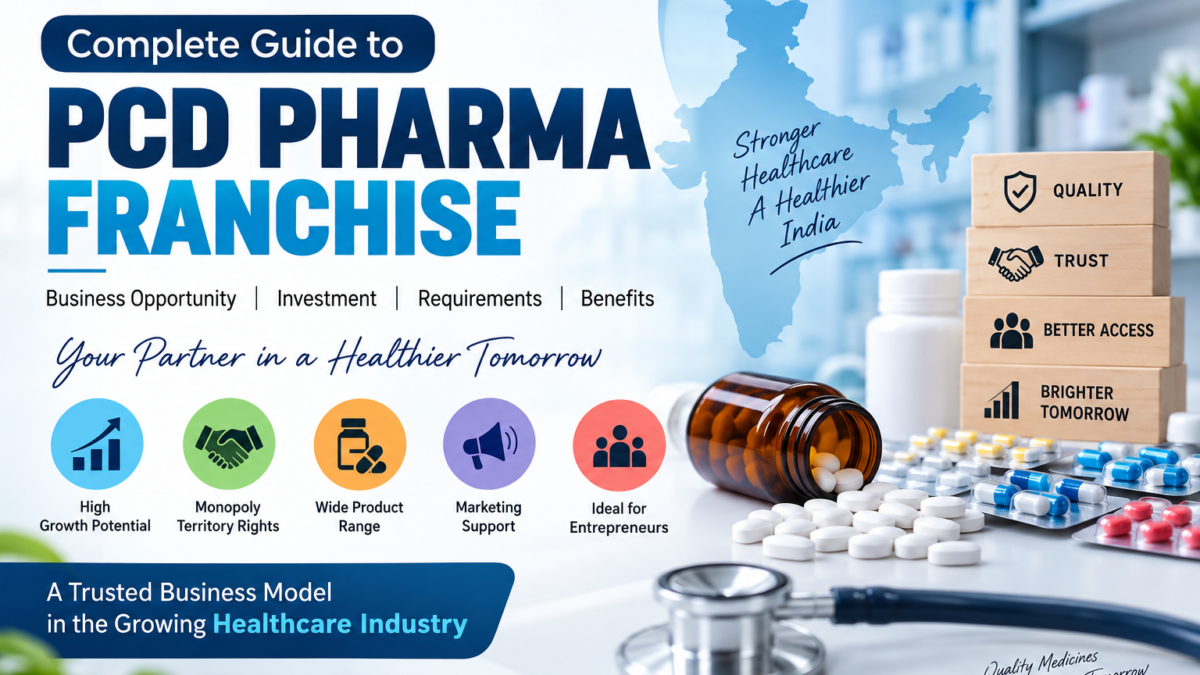
The PCD pharma franchise model has become a popular way for entrepreneurs, medical representatives, distributors, and healthcare professionals to enter the pharmaceutical distribution business without setting up their own manufacturing facility. In this model, a pharmaceutical company provides its branded products and marketing support to a franchise partner for a defined territory.
PCD stands for Propaganda Cum Distribution. The franchise partner generally purchases products from the pharmaceutical company and promotes and distributes them within the agreed market. Depending on the company and agreement, the partner may also receive territory-based monopoly rights.
If you are planning to start a pharmaceutical business, understanding the PCD model, investment requirements, documentation, product selection, and company evaluation criteria is important before making a commercial decision.
PCD stands for Propaganda Cum Distribution. The franchise partner generally purchases products from the pharmaceutical company and promotes and distributes them within the agreed market. Depending on the company and agreement, the partner may also receive territory-based monopoly rights.
If you are planning to start a pharmaceutical business, understanding the PCD model, investment requirements, documentation, product selection, and company evaluation criteria is important before making a commercial decision.
What Is a PCD Pharma Franchise?
A PCD pharma franchise is a business arrangement between a pharmaceutical company and an independent franchise partner. The pharmaceutical company provides access to its product portfolio, while the franchise partner handles local promotion, distribution, and customer relationships.
The business relationship generally involves three key parties or components:
- Pharmaceutical company: Manufactures and supplies the medicines.
- Franchise partner: Promotes and distributes the products.
- Defined territory: The geographical area where the partner operates.
A PCD franchise can be established at a city, district, state, or other mutually agreed territory, depending on the company’s business model.
How Does the PCD Pharma Franchise Model Work?
The process is relatively straightforward:
Pharma Company → Franchise Partner → Doctors/Clinics/Chemists → Patients
The pharmaceutical company develops and supplies the products, while the franchise partner focuses on building the local market.
The typical process includes:
- Selecting a pharmaceutical company.
- Discussing the available territory.
- Reviewing the product range and pricing.
- Completing required documentation.
- Signing the relevant business agreement.
- Placing the initial product order.
- Starting local promotion and distribution.
Tip: Always understand the territory, pricing, product availability, payment terms, and other commercial conditions before placing an order.
Why Choose a PCD Pharma Franchise?
There are several reasons entrepreneurs explore this business model.
1. Lower Entry Barrier
Unlike pharmaceutical manufacturing, a PCD franchise does not require you to establish your own manufacturing plant. You work with an existing pharmaceutical company and its product portfolio.
2. Ready Product Portfolio
The parent company may provide products across different therapeutic categories, such as:
- General medicines
- Cardiac and diabetic products
- Gastrointestinal medicines
- Orthopaedic products
- Neuropsychiatric products
- Gynaecology products
- Paediatric medicines
- Nutraceuticals
- Ayurvedic products
3. Territory-Based Business
Many PCD companies offer monopoly or exclusive territory arrangements. However, the exact terms vary between companies, so the agreement should clearly define the territory and applicable conditions.
4. Marketing Support
Depending on the company, franchise partners may receive promotional materials such as:
- Product cards
- Visual aids
- Product brochures
- Samples
- Promotional literature
- Product information
PCD Pharma Franchise Investment
The investment required for a PCD franchise depends on factors such as the territory, product range, initial order quantity, business infrastructure, and company-specific terms.
Some current industry guides cite entry-level investments in the range of ₹25,000 to ₹1,00,000, while larger or broader product portfolios can require significantly more capital. These figures are indicative rather than universal.
Indicative Investment Structure
| Business Requirement | Indicative Cost |
|---|---|
| Initial product stock | ₹25,000–₹1,00,000+ |
| Business setup | Depends on requirements |
| Licensing & registrations | Varies by state and business |
| Marketing expenses | Depends on territory |
| Working capital | Depends on sales cycle |
| Transportation & logistics | Location dependent |
Important: Actual costs can vary considerably. Before investing, request a detailed quotation and commercial terms from the pharmaceutical company.
Documents Required for a PCD Pharma Franchise
Pharmaceutical distribution is a regulated activity, so appropriate licences and registrations may be required.
Common Business Requirements
Depending on the nature and location of your business, these may include:
- Drug licence
- GST registration
- PAN
- Business registration documents
- Address proof
- Bank account
- Relevant premises documents
- Other state-specific regulatory documents
For example, some PCD guides identify drug licensing and GST registration among the important requirements for starting the business.
Check Your State Requirements
Requirements can differ based on the business structure, product category, and state regulations. Therefore, verify the applicable requirements with the relevant State Drug Control Department before beginning operations.
You can also explore official information through the Central Drugs Standard Control Organisation for broader regulatory information.
How to Select the Right PCD Pharma Company
Choosing the pharmaceutical company is one of the most important parts of starting a PCD franchise.
Quality and Certifications
Check whether the company has appropriate manufacturing and quality certifications. Do not rely solely on certification logos displayed on a website; verify the documentation where appropriate.
Product Portfolio
A wider product portfolio can provide more options, but quantity alone should not determine your decision.
Consider:
- Product demand
- Therapeutic categories
- Dosage forms
- Product quality
- Pricing
- Packaging
- Availability
- Market competition
Territory Rights
If monopoly rights are offered, ask for the territory and conditions in writing.
Questions to Ask the Company
Before signing an agreement, ask:
- Is my territory exclusive?
- Which products are covered?
- What is the minimum order requirement?
- What are the payment terms?
- How quickly are orders dispatched?
- What promotional materials are provided?
- What happens if a product becomes unavailable?
- What are the conditions for continuing or ending the agreement?
PCD Pharma Franchise vs Third-Party Manufacturing
Although both models involve pharmaceutical companies, they work differently.
| Factor | PCD Pharma Franchise | Third-Party Manufacturing |
|---|---|---|
| Brand ownership | Usually parent company | Usually client/company ordering manufacturing |
| Manufacturing | Parent/manufacturing company | Third-party manufacturer |
| Territory | Often defined | Generally not the central feature |
| Marketing | Franchise partner | Brand owner |
| Initial investment | Generally lower | Can be higher depending on MOQ |
| Best suited for | Distributors and entrepreneurs | Businesses building their own brands |
Understanding this distinction can help you select the business model that matches your objectives.
Steps to Start a PCD Pharma Franchise
Step 1: Research the Market
Study your local market and identify the products and therapeutic categories with potential demand.
Step 2: Shortlist Companies
Compare multiple companies based on product quality, certifications, pricing, territory policy, supply capability, and business support.
Step 3: Select Your Territory
Choose a location where you can realistically develop relationships with doctors, pharmacies, distributors, clinics, or hospitals.
Step 4: Complete Documentation
Arrange the applicable licences, registrations, and business documents.
Step 5: Finalise Products
Select products based on your market requirements rather than ordering an unnecessarily large portfolio.
Step 6: Place Your First Order
Start with an appropriate product mix and maintain sufficient working capital for repeat orders and operational expenses.
Step 7: Build Your Distribution Network
Develop relationships with relevant healthcare and distribution channels and maintain consistent product availability.
Benefits and Considerations of a PCD Franchise
Potential Benefits
- Established product portfolio
- Lower infrastructure requirement than manufacturing
- Opportunity to operate within a defined territory
- Marketing support from the parent company
- Scope to expand the product portfolio
- Potential to build a long-term distribution network
Important Considerations
However, a PCD franchise is still a business and does not guarantee profits.
Your results can depend on:
- Local market demand
- Product acceptance
- Competition
- Pricing
- Doctor and retailer relationships
- Inventory management
- Company supply reliability
- Working capital
- Regulatory compliance
Therefore, conduct proper market research and commercial due diligence before investing.
Conclusion
A PCD pharma franchise can provide an entry route into pharmaceutical distribution by combining an existing product portfolio with a territory-focused business model. Instead of developing medicines and manufacturing infrastructure independently, the franchise partner focuses primarily on marketing, distribution, customer relationships, and territory development.
The right approach is to evaluate the pharmaceutical company carefully, verify its documentation, understand the commercial agreement, assess your local market, and start with a manageable product portfolio.
If you are comparing opportunities, create a checklist covering product quality, certifications, territory rights, pricing, minimum order requirements, marketing support, supply reliability, and regulatory requirements before making your final business decision.
Frequently Asked Questions
What does PCD stand for?
PCD stands for Propaganda Cum Distribution. It refers to a business arrangement in which a pharmaceutical company gives a partner rights to promote and distribute its products within an agreed territory.
How much investment is required for a PCD pharma franchise?
The investment varies according to the company, territory, product portfolio, and order size. Some current industry guides cite entry-level figures from approximately ₹25,000 to ₹1 lakh, but actual requirements can be higher.
Is monopoly territory available with every PCD company?
No. Territory or monopoly arrangements depend on the company’s business policy and the terms agreed with the franchise partner. Always confirm the exact territory and conditions in writing.
Can a beginner start a PCD pharma franchise?
Yes, the model is commonly explored by first-time entrepreneurs, medical representatives, chemists, distributors, and healthcare professionals, although the applicable licences, investment, and business requirements should be assessed beforehand.