



How to Select the Right Pharma Products for Your PCD Franchise Business
How to Choose the Right PCD Pharma Franchise Company in India
October 8, 2026How to Start a PCD Pharma Franchise Business in India
October 8, 2026Quick Answer
Choosing the right pharma products for a PCD franchise depends on more than product demand or profit margin. Franchise owners should evaluate local demand, therapeutic segments, competition, product quality, pricing, MOQ, shelf life, and supply. Select products that match your target market instead of choosing a large product list without proper research.
If you are wondering how to select the right pharma products for your PCD Pharma franchise business, then start by checking local demand and competition, territory needs, budget, and many more. In this blog, we have explained the key factors you should consider to choose the right products and build a suitable PCD pharma product list for your market. Choosing the right products is more important than selecting a large product list catalogue.
A medicine may sell well in one area but have low demand in another. Similarly, a product with a high margin may not perform well if doctors rarely prescribe it. Therefore, PCD pharma product selection should focus on market demand, product quality, competition, and business potential rather than simply choosing more products.
Key Points for Selecting the Right PCD Pharma Products
- Check local market demand before choosing products.
- Select therapeutic segments that match your doctor network.
- Check competition for key medicines and formulations.
- Compare quality, documents, pricing, MOQ and shelf life.
- Do not choose products only for high profit margins.
- Start with a manageable product range and track sales.
- Check regulatory and labelling requirements.
- Choose a PCD pharma company that offers regular supply and proper franchise support.
What Is PCD Pharma Product Selection?
PCD Pharma product selection means choosing the right medicines, formulations, therapeutic segments, dosage forms, and pack sizes for your franchise business. A simple way to select products is:
Demand → Territory → Competition → Doctor Fit → Pricing → Quality → Supply
This will help you to choose products based on your actual market needs instead of simply copying another company’s product list.
Why Is Product Selection Important for a PCD Franchise Business?
The right product range can affect your investment, doctor coverage, sales, and repeat orders. It also helps you to manage your inventory and working capital better. A focused PCD pharma product portfolio is often easier to promote and manage than a large product list that does not match your market.
Your product selection can affect:
- Initial investment
- Doctor and retailer coverage
- Product sales and repeat orders
- Inventory movement
- Marketing needs
- Working capital
- Business growth
How to Select the Right Pharma Products for Your PCD Franchise Business: 7 Factors to Consider
Choosing the right PCD pharma products requires proper market research. Check your local demand, competition, doctor network, product quality, pricing, and supply before finalising your product range. Let’s understand the 7 key factors to consider before selecting PCD pharma products.
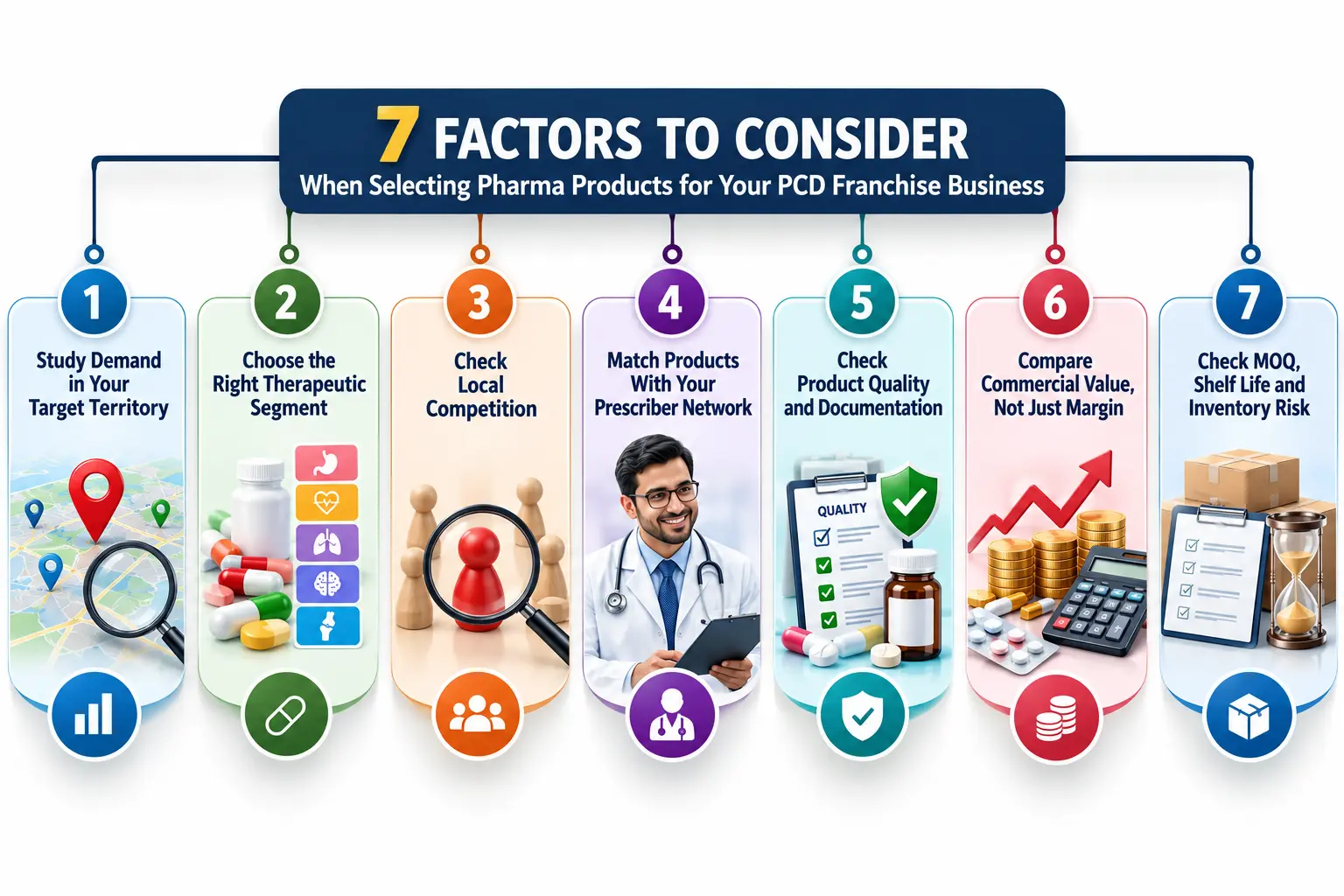
1. Study Demand in Your Target Territory
Start by understanding your local market instead of directly choosing products from a company’s catalogue. Choose products that match the healthcare demand of your territory. This can help you to build a more relevant and practical product portfolio.
Check:
- Common healthcare needs
- Clinics and hospitals
- Doctors and specialists
- Chemists and pharmacies
- Existing distributors
- Seasonal demand
- Commonly prescribed medicines
2. Choose the Right Therapeutic Segment
Do not try to cover every category at once. Choose therapeutic segments that match your doctor network, market demand and business plan. For example, if you mainly work with paediatrics, a pediatric PCD product range may be more suitable than investing in unrelated categories.
You can consider:
- General medicine
- Pediatric
- Gynae
- Gastro
- Cardiac and diabetic
- Derma
- Orthopedic
- Neuro
- Nutraceuticals
- Critical care
3. Check Local Competition
A popular medicine is not always the right product for your market. So before selecting a product, check:
Molecule → Strength → Dosage Form → Pack Size → MRP → Competing Brands
Also consider:
- Number of competing brands
- Market price
- Established companies in the segment
- Scope for a new brand
4. Match Products With Your Prescriber Network
Your PCD pharma product list should match the doctors you can approach and promote products to. This creates a better prescriber-product fit and makes product promotion and available documents.
| Prescriber Network | Suitable Product Areas |
| General physicians | General medicine, gastro, pain management |
| Pediatricians | Syrups, drops, suspensions |
| Gynecologists | Gynae and women’s healthcare |
| Dermatologists | Creams, gels, lotions |
| Orthopedics | Pain and orthopaedic products |
| Physicians/diabetologists | Cardiac and diabetic products |
5. Check Product Quality and Documentation
Before adding a product to your PCD pharma product range, check its quality and available documents. Remember that regulatory requirements can be different depending on the type of product.
Verify:
- Product composition
- Manufacturing details
- Manufacturing license
- GMP/quality certifications, where applicable
- Certificate of Analysis (COA)
- Product specifications
- Storage conditions
- Shelf life
- Packaging and labelling
- Applicable regulatory approvals
If you are still confused about choosing the right company? Read our guide on how to choose the right PCD pharma franchise company.
6. Compare Commercial Value, Not Just Margin
Do not select a product only because it offers a high profit margin. Consider the complete cost and sales potential.
Check: Purchase Price + MRP + Trade Margin + MOQ + Freight + Promotional Cost + Inventory Risk
A product with a lower margin but better sales movement may be more practical than a high-margin product that stays in stock.
7. Check MOQ, Shelf Life and Inventory Risk
Choosing products based on actual demand can help to reduce slow-moving inventory and unnecessary working-capital pressure. So before ordering, check:
- Minimum Order Quantity (MOQ)
- Pack size
- Shelf life
- Storage requirements
- Replacement policy
- Expiry handling
- Replenishment time
- Product availability
5-Step Process to Shortlist PCD Pharma Products
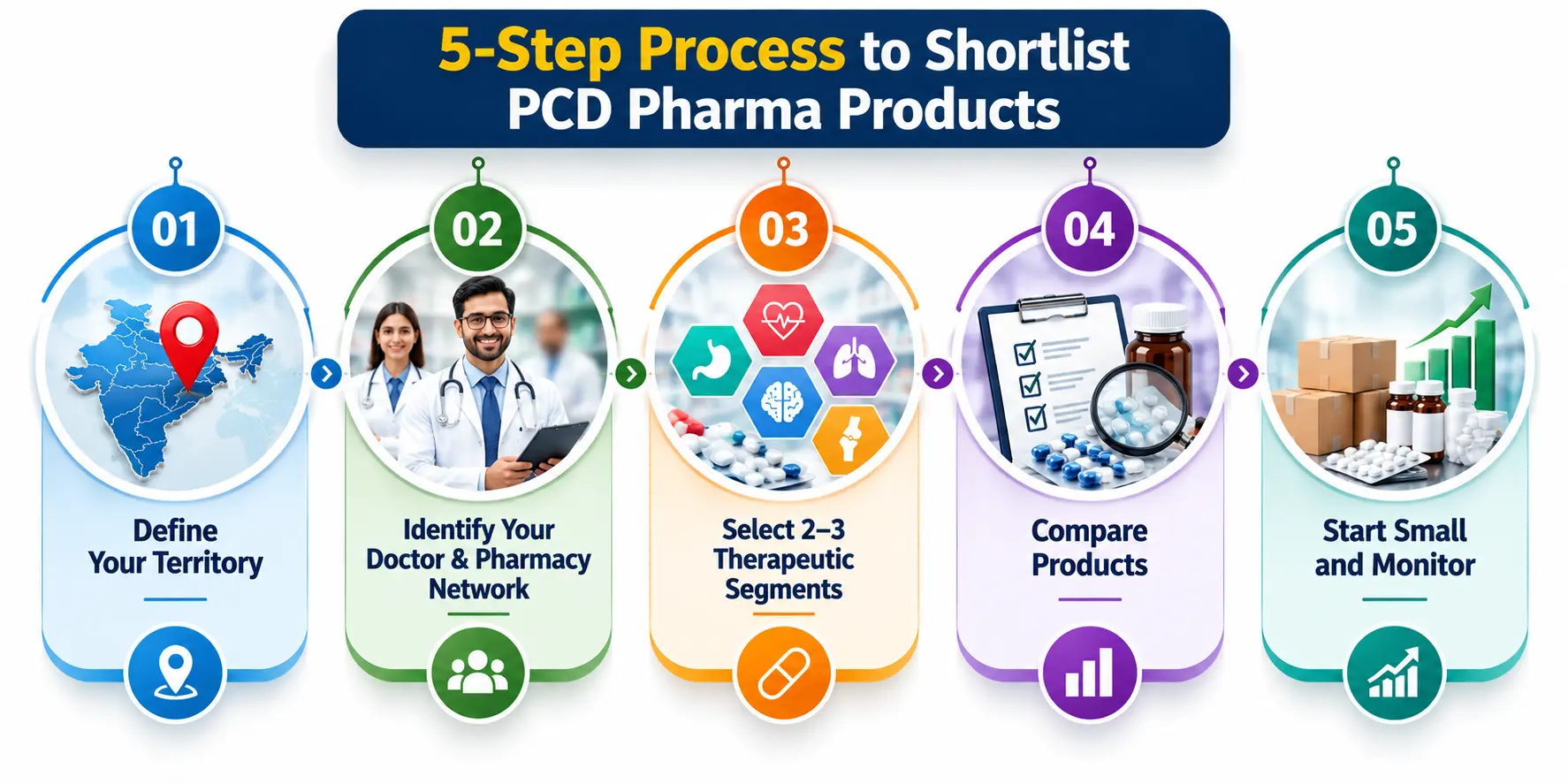
- Step 1: Define your target territory.
- Step 2: Identify your strongest doctor and pharmacy network.
- Step 3: Select two or three relevant therapeutic segments.
- Step 4: Compare products based on demand, competition, quality and commercial terms.
- Step 5: Start with a manageable portfolio and monitor product movement before expanding.
Which PCD Pharma Product Categories Can You Consider?
Different PCD pharma product categories may suit different markets and doctor networks. Choose the categories based on your local demand, prescriber networks, and business plan.
| Therapeutic Segment | Common Forms | Suitable For |
| General Medicine | Tablets, capsules, syrups | General physician network |
| Pediatric | Syrups, drops, suspensions | Pediatric doctors |
| Gynae | Tablets, capsules, syrups | Women’s healthcare |
| Derma | Creams, gels, lotions | Dermatology market |
| Cardiac & Diabetic | Tablets, capsules | Chronic-care network |
| Gastro | Tablets, capsules, syrups | General physicians |
| Orthopedic | Tablets, capsules, gels | Orthopaedic and pain care |
| Nutraceuticals | Capsules, powders, sachets | Supplement market |
Conclusion
Choosing the right PCD pharma products is not only about high demand or high profit margins. You should also check local demand, competition, doctor network, product quality, pricing, MOQ, inventory, and supply before selecting your products. In the above blog, we have mentioned some factors to consider while choosing products for a PCD franchise business. We hope this guide helps you understand your market better and select products that match your demand, doctor network, budget and business goals.
Moreover, if you are looking for a PCD pharma franchise opportunity, Bidu Biotech can help you explore its PCD product range, franchise terms and business requirements before you finalize your product list.
FAQs (Frequently Asked Questions)
How many products should I start with in a PCD franchise?
There is no fixed number. Your starting portfolio should depend on your budget, territory, prescriber network, therapeutic focus and expected product movement.
Should I choose PCD products based on profit margin?
No. Margin should be considered along with demand, competition, pricing, inventory risk, MOQ and expected movement.
What should I check before buying PCD pharma products?
Check product composition, applicable regulatory requirements, manufacturing information, quality documentation, pricing, MOQ, shelf life, storage requirements and supply terms.
What is the first step in selecting PCD pharma products?
The first step is to understand your target territory, including local healthcare demand, doctor network, pharmacy presence, competition and relevant therapeutic segments.
Should new PCD franchise owners start with fewer products?
A focused starting portfolio can help new franchise owners control inventory and concentrate promotional efforts. The appropriate range depends on budget, territory and expected product movement.
Why is shelf life important when selecting PCD products?
Shelf life affects inventory risk. Products with limited remaining shelf life may be difficult to move before expiry, especially when opening quantities are high.
Get Product List
Contact Us