



PCD Pharma Franchise vs Pharma Distribution: Which Business Model Is Different?

PCD Pharma Franchise: Complete Guide to Starting a Pharma Business in India
September 23, 2026How to Choose the Right PCD Pharma Franchise Company in India
October 8, 2026
The pharmaceutical business in India offers many opportunities for people who want to start a business, but two common models are PCD Pharma Franchise and Pharma Distribution. Both involve selling and promoting pharmaceutical products, but their business structure, investment needs, responsibilities, and growth options can be different. Knowing these differences is important before choosing a business model.
India has one of the largest pharmaceutical industries in the world and ranks 3rd globally by pharmaceutical production volume. The country’s domestic pharmaceutical market was valued at around USD 60 billion in FY26 and is expected to reach approximately USD 130 billion by 2030, creating opportunities in manufacturing, distribution, marketing, and franchise businesses. India also supplies around 20% of the world’s generic medicines, showing the size and strength of its pharmaceutical industry.
For business owners, the pharmaceutical market can offer benefits such as rising healthcare needs, many types of products, regular demand for medicines, and chances to grow into new areas. A PCD Pharma Franchise can be a good option for people who want to start with lower investment and work in a fixed area. On the other hand, pharma distribution usually means buying and supplying medicines to a wider network of retailers, hospitals, pharmacies, and other businesses. It may need more money, stock management, storage, and other business facilities.
Therefore, the right model depends on your budget, business size, territory, product range, and future growth plans.
PCD Pharma Franchise vs Pharma Distribution

What Is a PCD Pharma Franchise?
A PCD Pharma Franchise is a business model where a pharmaceutical company allows a person, medical representative, distributor, or business partner to promote and sell its products in a particular area. The franchise partner gets the right to market and sell the company’s products within an agreed territory.
In this business model, the pharmaceutical company usually provides the products, product information, promotional materials, and marketing support. The franchise partner mainly works on building relationships with doctors, pharmacies, healthcare professionals, and other customers in the assigned area.
One of the main reasons people choose a PCD Pharma Franchise business is that it can be started with a manageable investment. A person can start with a selected range of products and slowly add more products as the business grows and demand increases.
Key Features of PCD Pharma Franchise
- Marketing rights for a specific territory
- Comparatively lower starting investment
- Access to an established range of pharmaceutical products
- Marketing and promotional support from the company
- Opportunity to build a local customer and retailer network
- Chance to grow by adding more products
- Suitable for individuals and small to medium-sized business owners
A PCD Pharma Franchise Company can offer products in different categories, such as tablets, capsules, syrups, injections, powders, ointments, and other pharmaceutical products.
What Is Pharma Distribution?
Pharma distribution is a business model where a distributor buys pharmaceutical products from manufacturers or pharmaceutical companies and supplies them to pharmacies, hospitals, clinics, retailers, institutions, and other buyers.
A distributor plays an important role in making sure medicines are available when they are needed. For this, the distributor needs to manage stock, storage, transportation, billing, orders, and relationships with different retailers or business customers. Unlike a PCD franchise, pharma distribution mainly focuses on buying, storing, and supplying medicines rather than promoting products in a specific territory.
A pharma distributor can deal with products from one or more pharmaceutical companies, depending on the business agreement, company policies, and distribution network.
Key Features of Pharma Distribution
- Focus on buying and supplying medicines
- Needs proper stock and inventory management
- Usually involves a wider network of retailers and institutions
- May require more working capital for maintaining stock
- Requires proper storage and transportation facilities
- Income mainly depends on sales volume and distribution margins
- Can support a larger pharmaceutical business and supply network
Quick Check: PCD Pharma Franchise vs Pharma Distribution
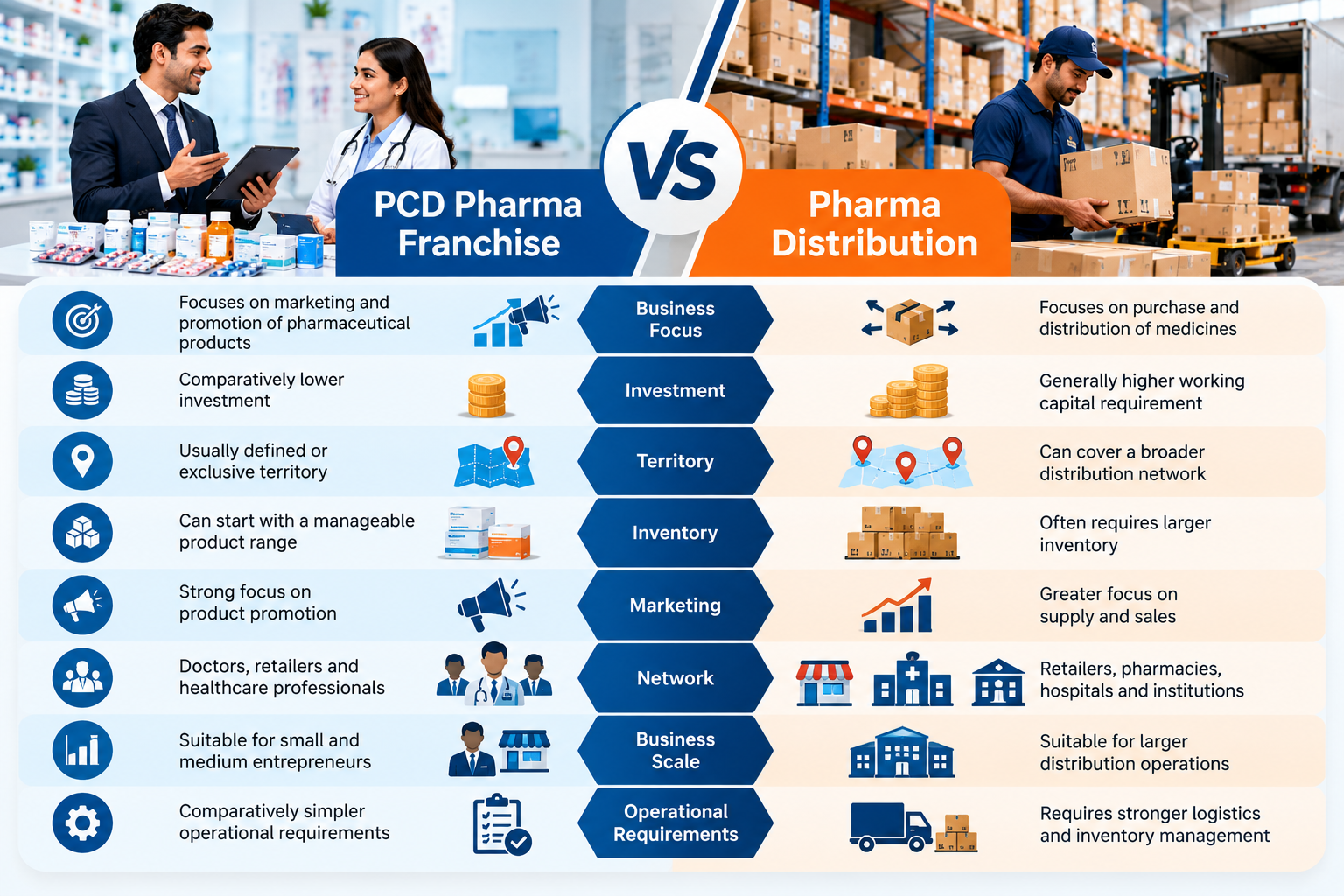
Although both models operate within the pharmaceutical industry, their working methods are different. Understanding these differences can help entrepreneurs select a business model according to their budget and objectives.
| Factor | PCD Pharma Franchise | Pharma Distribution |
| Business Focus | Marketing and promotion of pharmaceutical products | Purchase and distribution of medicines |
| Investment | Comparatively lower | Generally higher working capital requirement |
| Territory | Usually defined or exclusive territory | Can cover a broader distribution network |
| Inventory | Can start with a manageable product range | Often requires larger inventory |
| Marketing | Strong focus on product promotion | Greater focus on supply and sales |
| Network | Doctors, retailers and healthcare professionals | Retailers, pharmacies, hospitals and institutions |
| Business Scale | Suitable for small and medium entrepreneurs | Suitable for larger distribution operations |
| Operational Requirements | Comparatively simpler | Requires stronger logistics and inventory management |
PCD Pharma Franchise vs Pharma Distribution – Key Differences
Business Ownership and Working Structure
PCD Pharma Franchise – A PCD partner gets authorization from a pharmaceutical company to promote and sell its products within a defined territory. The partner usually works independently and manages local sales, customer relationships, and business development.
Pharma Distribution – A pharma distributor purchases medicines from pharmaceutical companies and supplies them to pharmacies, retailers, hospitals, clinics, or other buyers. The main focus is maintaining product availability and managing the supply chain.
Investment and Working Capital
PCD Pharma Franchise – A PCD Pharma Franchise can generally be started with a comparatively manageable investment. Partners can begin with selected products and increase their portfolio as the business grows.
Pharma Distribution – Pharma distribution may require higher working capital because distributors often need to maintain larger inventories, manage regular purchases, transportation, storage, and customer credit requirements.
Territory and Market Coverage
PCD Pharma Franchise – PCD companies commonly provide a specific geographical territory to their partners. Depending on the agreement, the partner may receive exclusive or protected rights for marketing the company’s products in that area.
Pharma Distribution – Distributors generally focus on supplying products across a wider network of pharmacies, retailers, hospitals, clinics, and institutions. Their market coverage depends on the company’s distribution arrangements and local business network.
Product Promotion
PCD Pharma Franchise – PCD partners are generally responsible for promoting the company’s products within their assigned territory. They may receive product information, promotional materials, and other marketing support from the pharmaceutical company.
Pharma Distribution – Distributors primarily focus on purchasing, stocking, and supplying medicines. Product promotion may be less central to their role, although distributors often support sales by maintaining retailer relationships and communicating product availability.
Inventory Management
PCD Pharma Franchise – PCD partners can usually manage inventory according to the demand generated in their territory. Starting with a focused product range can make inventory management comparatively easier.
Pharma Distribution – Inventory management is a major part of pharma distribution. Distributors may handle products from multiple companies and need to monitor stock levels, expiry dates, storage conditions, orders, and deliveries.
Customer Network
PCD Pharma Franchise – PCD partners generally develop a local network involving pharmacies, doctors, healthcare professionals, and other relevant customers, depending on the products and applicable regulations.
Pharma Distribution – Pharma distributors mainly build relationships with retailers, pharmacies, hospitals, clinics, institutions, and other buyers that regularly purchase pharmaceutical products.
Business Expansion
PCD Pharma Franchise – Partners can gradually expand by increasing product sales, adding products, strengthening their local network, and exploring additional opportunities according to their agreement with the pharmaceutical company.
Pharma Distribution – Distributors can expand by increasing their retailer network, adding more products or companies, improving logistics, increasing inventory capacity, and entering additional markets.
Operational Responsibilities
PCD Pharma Franchise – The PCD partner generally manages local marketing, sales development, customer relationships, order generation, and day-to-day business activities within the assigned territory.
Pharma Distribution – A distributor has broader operational responsibilities related to procurement, warehousing, inventory control, order processing, billing, transportation, and timely delivery.
Profit and Revenue Model
PCD Pharma Franchise – Earnings generally depend on the sales generated through the products marketed within the assigned territory. Profitability can vary based on product demand, pricing, expenses, and the commercial terms agreed with the pharmaceutical company.
Pharma Distribution – Revenue is primarily generated through the difference between the purchase price and selling price or the applicable distribution margin. Sales volume, inventory turnover, operating costs, and credit cycles can significantly affect profitability.
Final Words – PCD Pharma Franchise or Pharma Distribution: Which One Should You Choose?
The choice depends mainly on your investment capacity, business objectives, operational capabilities, and desired scale.
If you are a new entrepreneur looking for a comparatively lower-investment pharmaceutical business model, a PCD Pharma Franchise can be considered. It allows you to work with an established pharmaceutical company, build a territory-focused network, and expand gradually.
If you have higher working capital, stronger logistics capabilities, storage infrastructure, and plans to manage a larger supply network, pharma distribution may be more appropriate.
In simple terms, a PCD franchise is generally more focused on territory-based marketing and business development, while pharma distribution is more focused on large-scale product supply and inventory management.
Before starting, compare the company’s product quality, certifications, product range, pricing, promotional support, territory policy, minimum order requirements, and business terms. A detailed comparison can help you choose a pharmaceutical business model that fits your available resources and long-term plans.
Get Product List
Contact Us