



PCD Pharma Franchise Investment in India
How to Start a PCD Pharma Franchise Business in India
October 8, 2026PCD Pharma Franchise Business Plan: How to Plan Territory, Products, Doctors & Stock
October 9, 2026Quick Answer
To start a PCD Pharma Franchise in India, initial investment typically ranges from ₹50,000 to ₹2,50,000. Capital covers mandatory Drug License and GST fees, initial stock purchase, localized promotional materials, and basic storage setup.
“What is PCD Pharma Franchise Investment in India?” – It’s one of the very first questions asked by everyone thinking about launching a PCD pharma franchise business. And it’s the hardest question to give an exact answer to, since it depends on many factors such as your product range, company order minimums, the geography you’re covering, etc. What’s much more important in this case is the knowledge of what exactly you’re going to pay for.
In this guide, all possible costs associated with launching a PCD pharma franchise business in India will be described.
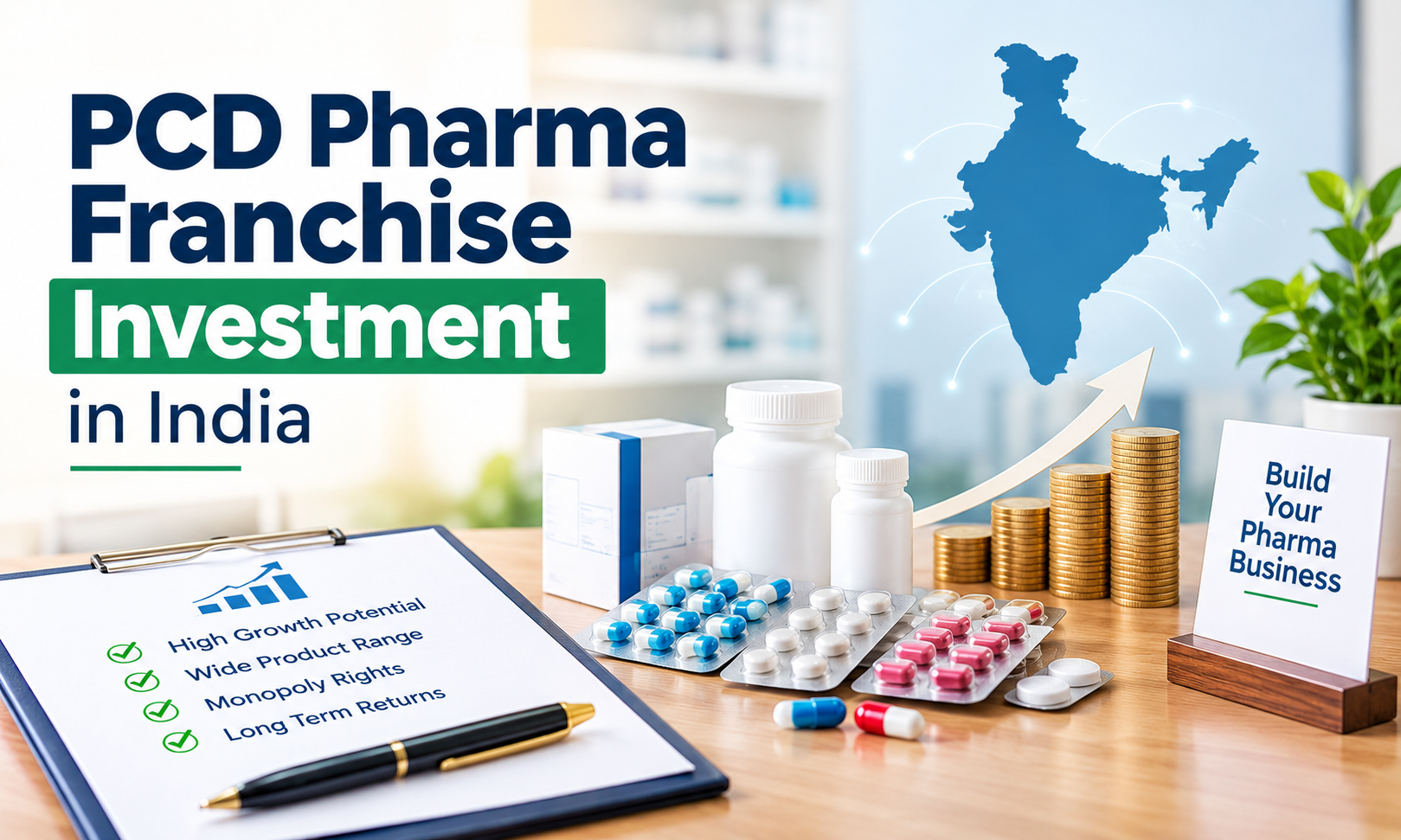
Why PCD Franchise Investment Varies So Much
Contrary to opening a manufacturing plant, there is no standard and consistent cost involved in opening a PCD franchise. Knowing the variables responsible for this variance is essential towards budgeting adequately.
Range of Products and Target Segment
For a range that includes only general products such as tablets and syrups, the amount of money you will need in stocking is less compared to one that includes specialised products such as injectables, cardiac-diabetics and nutraceuticals because pricing varies per category as well as the minimum order quantity.
Minimum Order Quantity of the Company
The minimum order quantity is the highest determining factor in the initial investment in every PCD firm and depends on each company since every firm has its unique MOV required for a first order. Some firms will require less MOV in an effort to facilitate their new franchise partners, whereas other firms may want high ones.
Core Components of Your Initial Investment
By breaking down the investment into its individual parts, it becomes much easier to budget for your needs rather than going with a general estimate.
First Order of Stocks
This will be your biggest expense and consists of your first order of medicines from the products that you have chosen. The amount may differ depending on the minimum order of the company and the product range you have decided to stock.
License Cost for Drugs
The process of licensing your drugs both wholesale and retail comes with an expense in terms of the license fees charged by the government in the state in question. There could also be an additional professional fee if you opt to employ the services of a consultant to help you in getting the license.
GST Registration
The GST registration process is free, but many business owners choose to go through a tax consultant for a hassle-free experience and hence incur an additional professional fee.
Advance Payment or Security Deposit
This is something that many franchise companies may ask for before they give you the franchise. It is different from the order of stocks.
Ongoing and Operational Expenses
Other than the initial investment, there are a few costs that would be incurred on a recurring basis.
Storage and Warehousing
Even a modest-sized storage facility for your inventory would entail rental costs (unless you run your operations from your own premises) and, if the product being stored is temperature-sensitive, costs associated with cooling.
Transportation and Logistics
The cost of transporting your inventory from the dispatch point at your company to your storage and, further, from your storage to chemists/stockists in your region would be an ongoing transportation cost that would vary depending on your order quantity and region.
Promotion and Marketing Materials
Whereas most companies do provide visual aids, literature, and samples to go with the franchise agreement, certain costs associated with marketing activities, visiting doctors, and gift items are usually borne by the franchisee.
Staff, if any
As your business starts growing and becomes more than what can be managed by one person, hiring a field representative or delivery driver would be a recurring staffing cost.
Understanding Minimum Order Value in PCD Pharma Franchise
This MOV factor is perhaps the most critical number you need to get clarified prior to signing up with any business because this number will ultimately determine your initial capital requirement.
How MOV Is Commonly Designed
In general, MOV can be calculated in terms of rupees or in terms of the minimum quantity required in your first order. Sometimes, some companies come up with a more flexible and relatively lower MOV requirement, especially for first-time franchise partners.
Why Lower MOV May Not Be Lower-Risk
While the low minimum order makes it easier to start up, it might pay to think twice and consider the product mix and margins that a particular business offers. A low MOV along with a highly limited product mix might put limits on your capability to cover doctors.
Typical Margin Structure and Return on Investment
Understanding how margins work helps you judge how quickly your initial investment might be recovered, though actual timelines depend heavily on how effectively you build prescriber relationships.
How PCD Margins Generally Work
Franchise partners typically purchase stock at a distributor price below MRP and earn margin on every sale to chemists, stockists, or hospitals. Margin percentages vary by product category and company, so it’s worth comparing rate lists across a few companies rather than accepting the first number offered.
Factors That Affect How Fast You Recover Your Investment
Recovery speed depends on how quickly you build doctor relationships and prescription volume, how well your chosen product range matches your territory’s prescriber base, and how consistently you reorder and restock popular products. A realistic timeline is measured in months of active, consistent marketing effort rather than an overnight return.
Hidden or Often-Overlooked Costs to Budget For
There are a couple of costs that surprise first-time franchisees since they are never explicitly discussed at first.
Expiration and Returns
Be sure to know how the company treats expired and unsold stocks because ambiguity in this area may lead to incurring losses for products that do not sell within their expiration period.
License and Renewal Costs
The license and renewals of drug licenses and other types of registrations usually cost money and will need to be planned for on an ongoing basis as a recurring cost and not a one-time cost.
Price Revisions
There may be price revision clauses in some contracts where the prices are revised periodically for certain products.
How to Get an Accurate Investment Estimate
Since so much depends on the company you choose, its products, and the area where you operate, the most reliable means of obtaining an accurate budget would be by requesting a written cost statement from your shortlisted companies.
Questions to Ask Before Making a Decision
Requesting the minimum order value, the rate list including your margin per item, whether there are any deposits required, and its return and price revision policies will help determine the right company to deal with.
Final Thoughts
PCD pharma franchise investment in India isn’t a single fixed number; it’s a combination of your first stock order, licensing costs, and ongoing operational expenses, all shaped by the company and product range you choose. Rather than chasing the lowest possible entry cost, it’s worth comparing the full picture — minimum order value, margin structure, support, and transparency — to find an investment that genuinely sets your business up for sustainable growth.
If you’d like a clear, written breakdown of investment and minimum order requirements, explore the PCD pharma franchise opportunities at Bidu Biotech, review the full product range to estimate costs for your preferred segment, or get in touch directly for a tailored investment estimate based on your territory and product preferences.
Get Product List
Contact Us